

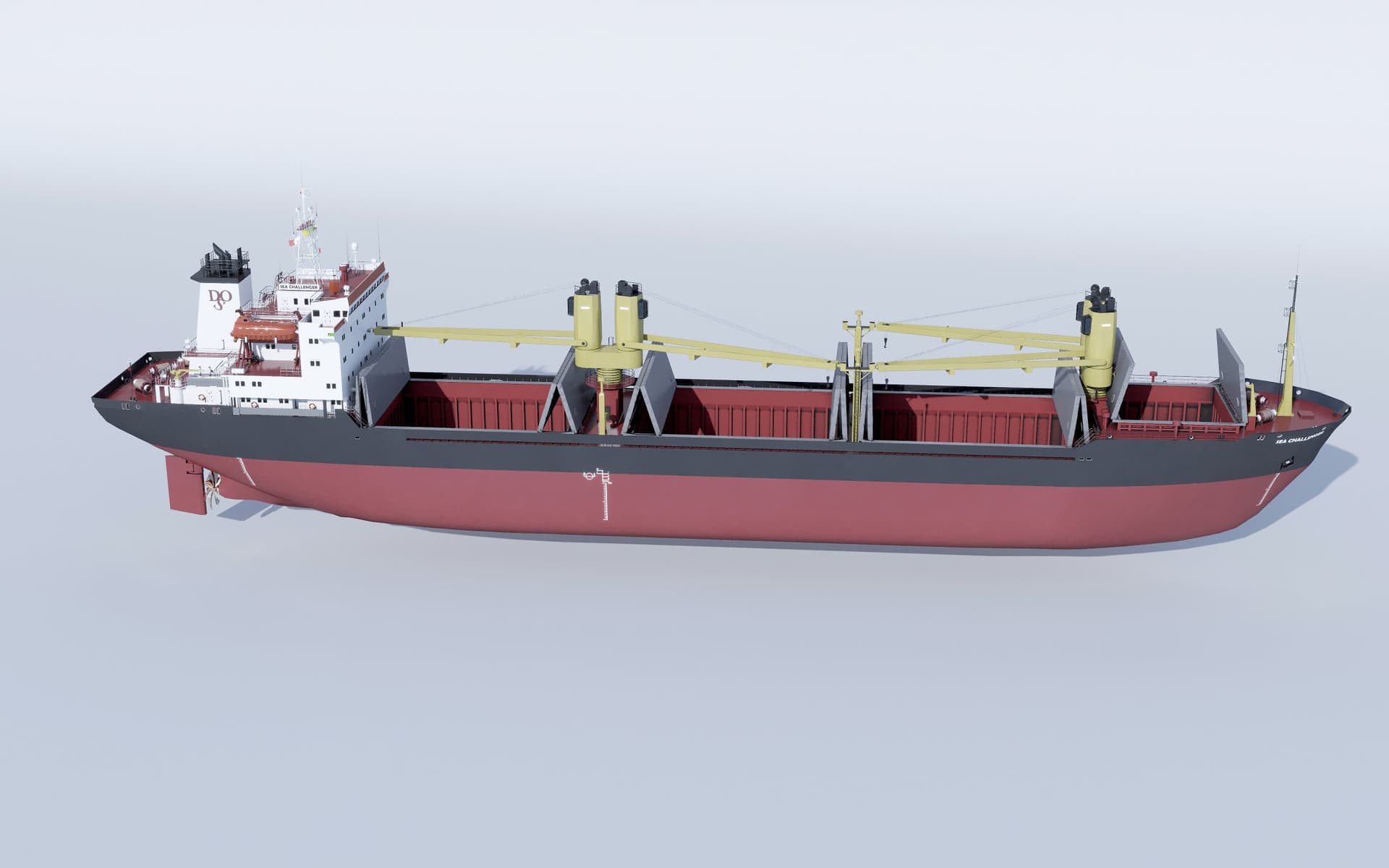
The Deadweight (DWT) in a listing shows a vessel's weight carrying capacity, meaning the combined weight of cargo, bunkers, water, stores and crew, not cargo alone. It says nothing about whether the vessel can carry steel without structural damage or rust claims. Here are the checks to make before you buy or charter.
A general cargo ship that looks suitable for steel on paper can lead to three costly outcomes if a few technical points go unchecked: rust and wet damage claims on the cargo, structural deformation in the tank top or hold sides, and rejection of the vessel by the Charterer before work even starts. All three weaknesses are usually predictable, and a technical inspection can uncover them before you sign the Memorandum of Agreement (MOA) for a sale or the Charter Party (C/P) for a charter.
Why DWT alone is not enough
DWT tells you how much weight a vessel can carry, but not how the hold copes with the cargo. Steel, and steel coils in particular, is a concentrated load. Unlike uniform bulk cargo, it puts pressure on a small number of points. A vessel with a suitable DWT may still have a weak Tank Top, worn Hatch Covers or a hold with an unsuitable shape.
Treat listings for General Cargo vessels as only the first screening step. The recorded particulars need to be checked against the Loading Manual, the class records and a technical inspection.
Tank top and point loads: where the uniform load assumption breaks down
The tank top is designed for uniform loading, but a coil is a concentrated load and raises tank top stress more than you would expect. Common structural rules generally assume the hold is filled with coils of the same size and weight. In practice, loading mixed coils is normal, and that is where the risk of overloading the tank top comes from.
The mechanism is simple. The weight of the coils in the upper tier passes downward only through the contact points, and friction between coils is negligible. If a lower coil is smaller, it and the floor take a larger share of the load. In one training example, the load on the tank top rose from 15 tonnes to 17.4 tonnes because of this change in arrangement. Treat it as a teaching example, not a figure that applies to every vessel; the point is the effect of mixing sizes.
Dunnage spreads the load, but it never makes the distribution fully uniform. More dunnage, wider dunnage and thicker dunnage all help, and dunnage thicker than one inch gives a better result. Before you buy or charter, ask for three things: the permitted point load limit for each hold under the Loading Manual; the approved coil loading conditions, since many vessels have only a limited number of them in the manual; and a calculation of the actual loading cases that will be carried out on this vessel. For a quick estimate of the load reaching the tank top with coils of equal size, the 50 percent rule applies, but it does not replace a formal calculation.
Coils resting against the hull push on the hull and the Hopper when the vessel heels or rolls. The slope and plate strength of the hopper, and the dynamic stress, should be compared with the permitted hull value in the manual or loading computer. Side dunnage protects the hull and hopper. If the inspection shows dents, waved plating or scattered repairs in these areas, take it seriously and reflect it in the price negotiation.
Hatch covers: weathertight, not watertight
A hatch cover is designed to a “weathertight” standard, not a fully “watertight” one. Any water that gets past the rubber gasket has to be drained away through the drains. Steel is easily damaged by salt water, so the hatches must be closed before loading and tested for weathertightness.
A hatch cover inspection should cover the condition of the rubber gasket, the cleats, the drains, the cross joint wedges, the non-return valves, the contact points and the compression bars. According to inspections by a Protection and Indemnity Club (P&I Club), the main causes of leaks are misaligned panels and incorrect pressure on the seal caused by wear on the metal contact surfaces. So do not stop at the look of the rubber; check panel alignment and contact as well.
An ultrasonic tightness test before loading should be part of the plan, leaks should be repaired and the bilge wells should be dry. In exposed areas, expanding foam and bitumen tape also help. After loading, the drainage channels must stay clean and the non-return valves free. An owner or technical manager who holds the documentation for these tests negotiates from a stronger position.
Strong points, hold shape and stability
The strong points of the floor, such as Solid Floors, should be marked on the tank top and up to the hold side, so that the position of dunnage and cargo can be checked during fast loading. If there is no such marking, record it as an operational shortfall and fix it before the first loading.
Avoid holds whose sides are not parallel. If you expect frequent steel loading, “square off” the space with steel or heavy timber supports. Hold No. 1 needs particular attention. Do not stow steel in the same hold as chemicals, fertiliser or sulphur.
Stability also has to be calculated for the proposed loading. When a large amount of steel sits on the hold floor, the centre of gravity drops and the metacentric height (GM) increases. The vessel becomes “stiff” and rolls sharply in severe weather, which can shift the cargo. If ballast or moving weights does not correct this, another stowage arrangement should be considered. Weather routing to avoid high waves is also recommended, because on narrow vessels these waves can cause parametric rolling.
Pre-signing checklist
The buyer should have an independent Marine Surveyor carry out the Pre-purchase / Condition Survey, with the scope written out clearly: the tank top and hopper plating, the condition of the welds and, where needed, non-destructive testing, the hatch covers, the mechanical and lifting equipment, and the electrical and fire-fighting systems. Referring each area to a specialist in that field lowers the risk of discovering a defect after delivery. Add a Class Records Inspection alongside it, so that the recommendations and restrictions of the Classification Society on loading and structure are clear.
In negotiation, and before the offer is firm, you would normally make the results of these inspections a condition through open Subjects, so that you have a way out or a price adjustment if a major finding appears. Under a Time Charter, the Charterer is best advised to carry out an On-hire Survey, covering the holds and hatch covers, before the charter begins. For the owner, a vessel that has completed and documented these checks in advance is usually less exposed to rejection or Off-hire.
If you plan to buy or charter a general cargo ship for steel cargo, search the listings on Shipo Market and ask for the Loading Manual and the inspection report before any negotiation. Owners with a vessel can list it for free and put the hold loading conditions next to the particulars. For a technical and commercial assessment of a specific vessel, you can contact me, Pooria Adli, directly at Shipo Market. No user's number is published, and contact between buyer and seller goes through our specialists.